

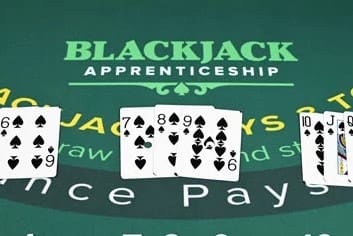
Card counting is a blackjack technique designed to provide blackjack players with a benefit over the casino. Card counting uses the difference in numbers of high cards and low cards remaining in the deck. More high cards in the deck means there is a better chance for the player to receive a blackjack (21, and fewer low cards mean there is a better chance for the dealer to have a strong hand. Using positive or negative values to assign to each card in the deck, players use a running tally of how many high and low cards remain.
Once a player has an estimate of how rich or thin the deck is in high cards, they can make decisions on what bets to place. Players place larger bets when the deck is richer in high cards and smaller bets when the deck is thinner in high cards. Card counting is a time-consuming process to learn; however once players understand the principles involved in card counting, they can potentially improve their average result from 48%, to 51%. Casinos do not approve of card counting. They can bar card counters from participating in future blackjack activity. Therefore, card counters must disguise their betting pattern and behavior to avoid suspicion from casino employees.
To accomplish this, card counters must act normally, engage in casual conversation with fellow players, and sometimes attempt to mirror the betting patterns of fellow players. In this article, I will discuss how to begin card counting; introduce you to several card counting systems; and also address ways to implement card counting without drawing unwanted attention to yourself.
Blackjack has two primary types of cards: high cards (10s-J-K-Q-A), which are beneficial to the player, and low cards (2-6), which favor the dealer. Tens and Ace cards provide the player with additional opportunities to create blackjacks and achieve totals of 20 or 21. Low cards provide the dealer with additional opportunities to produce stronger total values than those available to the player. Card counting utilizes this principle by providing a measure of the quantity of high and low cards remaining in the shoe.
Each card is provided with either a positive or negative count value. As cards continue to be played from the shoe, the player maintains a running tally of his/her count. At any point during the game, the running count represents an approximation of the number of high and/or low cards remaining in the shoe. When the running count is high, more high cards are in the shoe and therefore more advantageous to the player.
Conversely, when the running count is low, there are more low cards in the shoe and therefore more favorable to the dealer.
Players can maximize their bets by wagering at their greatest disadvantage when their running count is at its lowest.

To count cards at a blackjack table, follow these basic steps:
Determine the amount to assign to each card according to your chosen system. Most systems award each high card a negative score (-1,-2,-3), each low card a positive score (+1,+2,+3), and middle cards a neutral score (0).
Maintain a running count of every card played. Add or subtract the assigned values from your current count. For example: If your running count is +5 and a seven is played, your new count remains +5. If a five is played, subtract one from your new count to obtain a count of +4.
Divide your running count by the number of remaining decks in order to calculate an accurate count. Divide 100 by the number of remaining decks in order to convert your running count to an accurate count. Since you cannot divide fractions, round all decimal results down.
Deviate from your Basic Strategy as follows:
Using an effective card counting strategy at a blackjack table depends on a combination of discipline and knowledge:
The simplest method for counting cards involves assigning a positive value for each low card and a negative value for each high card, and maintaining a running total of both.
The most elementary method for counting cards is known as the Hi-Lo method. Assign a value of -1 for high cards, 0 for middle cards, and +1 for low cards.
As cards are dealt, maintain a running total by adding/subtracting the value associated with each card from your current total.
Example:
Pros of Essential Hi-Lo Method:
Cons:
Since it is essentially an introductory course for learning card counting fundamentals, the Hi-Lo system serves as an excellent starting point for students interested in developing a deeper appreciation for card counting.
Once you develop proficiency in applying the basic principles of card counting using Hi-Lo, you can transition to more sophisticated methods for improving player advantages. Two examples include:
These methods are more complex and require greater mastery but provide much larger potential advantages for experienced card counters. The drawback includes having to monitor more values and errors resulting from inaccuracies will be far more damaging.
Implementation of successful card counting techniques require discipline and ability:
Several misconceptions exist regarding card counting:
Card counting involves extensive periods of time devoted toward studying/practicing various techniques; thus it's not suitable for everyone. For most casual blackjack players utilizing basic strategy will suffice; however, employing card counting strategies will enable serious players with sufficient education/training to acquire up to 2% statistical advantage over casino houses.
Advantages of Card Counting:
Downside:
In conclusion, serious blackjack players who commit themselves fully to acquiring expertise/education relative to card counting can acquire up to 2% statistical edge relative to casinos.
Card counting is an advantage method that is based upon determining if the upcoming hand will provide an opportunity for the player to have an advantage over the house. An example would be using a mathematical process called tracking the ratio of high and low cards that remain in the deck. The high cards that remain in the deck help the player hit a blackjack and get paid 3:2, creating a favorable environment when there is more than one of them left in the deck. On the other hand, having too many of the lower cards (2-6) creates a disadvantageous situation for the player because they create a higher probability for the dealer to hit a natural.
Using card counting is simply assigning an amount of value to each card played (Positive, Negative, Neutral), adding those amounts together as each additional round is completed, and then converting that "running" count into a "true" count. As we add more rounds to our counts, we begin to understand how much of each type of card remains in the remaining portion of the deck(s). We use this true count to establish an estimate of our potential advantage.
One of the best-known and easiest-to-use card counting systems is the Hi-Lo System. In this system, each card is assigned a point value; 2-6 are +1, 7-9 are 0, and 10-Ace are -1. There are advanced card counting systems such as the Omega II and Knock-Out (KO) Systems that allow us to assign more precise values to individual cards and thus have a greater chance to gain an advantage. While these systems provide better accuracy and therefore a larger possible advantage than the Hi-Lo System, they also take longer to learn.
One benefit of card counting is that it gives you a statistically proven edge against the house. With a good level of skill and discipline, your edge could be anywhere from .5% to 2%. One drawback is that it takes a long period of time and experience to become proficient enough to rely on it as a viable means of increasing your winnings. Another major draw back is that once you have mastered a card counting system well enough to confidently apply it, you run the risk of being banned from any casino where you want to play blackjack. Additionally, even though card counting provides you with an advantage, you still face many variables that can affect your performance.
If you decide to spend the necessary time and energy learning how to become proficient with card counting, you will find it rewarding both financially and intellectually. Card counting makes playing blackjack more interesting by providing you with an opportunity to make smart decisions with respect to how you manage your money. Although it can be challenging to develop the skills needed to profitably use a card counting system, if you do succeed, you will find that it enhances your enjoyment of the game.



 Spin Palace Casino
 Jackpot City Casino
 Fairgo Casino
 Ruby Fortune Casino
 Lucky Nugget Casino
 Platinum Play Casino
 All Slots Casino
 Fortunium Gold Moolah Slot
 Lara Croft Fortune Slot
 Area Link Phoenix Slot
 Major Millions Slot
 Mega Vault Millionaire Slot
 Amazing Link Zeus Slot